Bee Aura Tech Corporation

LHDN MyInvois · Peppol · PINT-MY

E-invoicing in Malaysia, without the guesswork

Whether you are going live for the first time or leaving a provider that costs too much and delivers too little, Bee Aura Tech gets your invoices validated by LHDN and delivered over Peppol from your ERP, or from no system at all.
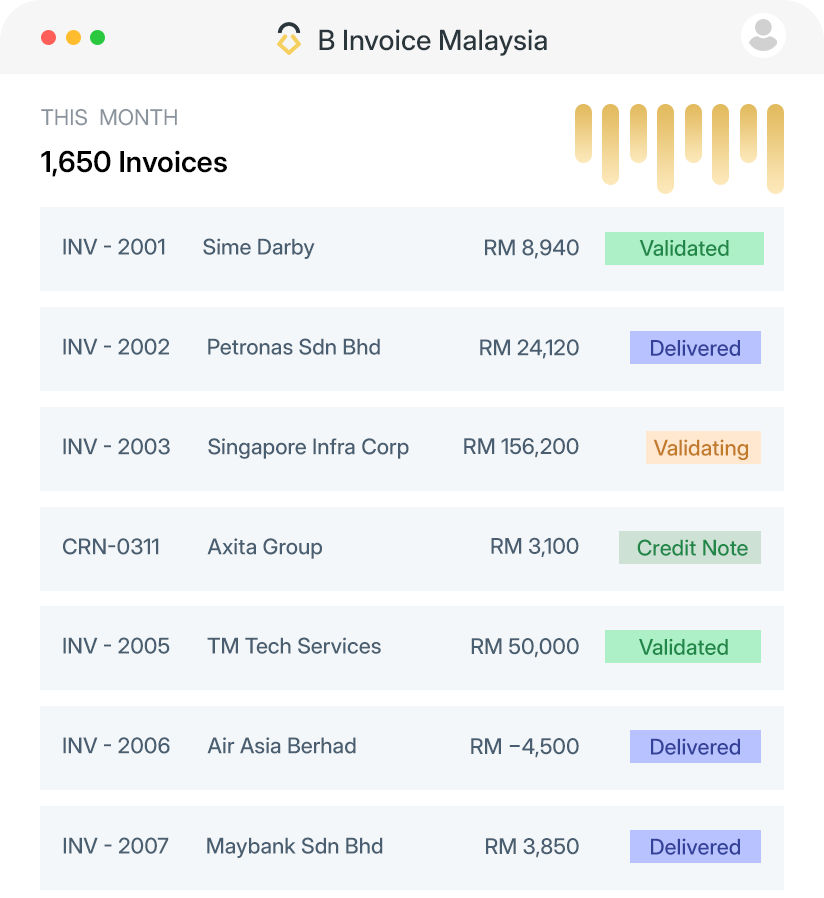
One platform for MyInvois clearance and Peppol delivery. Any ERP, or none. A migration that does not break your compliance.
Hero
PNT
LHDN
Flag
Tax

MyInvois

real-time validation

PINT-MY

& Peppol delivery

55-field

schema, handled for you

Any ERP

or manual entry

New, or switching

Get compliant, or get a better deal

Above RM1 million turnover, MyInvois is not optional we tell you your phase, connect your system and test before your date. Already live and paying too much? Your records sit with LHDN, not your vendor, so moving to us is smaller than your first setup and usually cheaper.

Instant estimate · takes 20 seconds

See your cost and what you could save

B Invoice · technical architecture

How an invoice travels from your system to LHDN
Seven steps, fully automated. Your ERP posts the invoice; we read it, validate it, clear it through MyInvois, deliver it over Peppol, check LHDN’s reply and write the result back to your ledger all without your finance team touching a government portal.

Your systems

Oracle Fusion · EBS

SAP S/4HANA · ECC

Dynamics 365

Infor · NetSuite

QuickBooks

Zoho · Sage
SQL · AutoCount · QNE

API · SFTP · Excel
Read & check

Errors caught early

Stored in your region

Global e invoicing compliance coverage by jurisdiction

Malaysia

Your data never leaves its own region

Converted to local format

Global e invoicing compliance coverage by jurisdiction

PINT-MY

Malaysia

Built to each country's spec

Cleared by the authority

Global e invoicing compliance coverage by jurisdiction

Malaysia LHDN MyInvois

Plus Oman, France, Vietnam, Colombia

Reply checked

Proof you complied

Back in your system

Oracle Fusion · EBS

SAP S/4HANA · ECC

Dynamics 365

Infor · NetSuite

QuickBooks

Zoho · Sage

SQL · AutoCount · QNE

UIN & status posted against the invoice

THROUGHOUT Nobody in finance changes how they work · Every step logged · Failed invoices retried automatically · Live status at all times

The rule, in plain terms

MyInvois validates every invoice before it counts

Malaysia runs a Continuous Transaction Control model. You submit an invoice to LHDN’s MyInvois platform, it is validated in near real time, and only then does it carry legal and tax standing. A PDF emailed to your customer is no longer an invoice — it is a copy of one.

01

Submit

Your invoice reaches MyInvois from your ERP through our API, over Peppol, by bulk upload, or keyed into our portal. Submission and validation happen in the same step.

02

Validate

LHDN checks the 55 data fields, your TIN, SST treatment and classification codes, then returns a Unique Identifier and a validated QR-coded document in near real time.

03

Deliver

The validated invoice goes to your buyer — as structured PINT-MY over Peppol, or as a human-readable copy. You have a 72-hour window to cancel and reissue if something is wrong.

MyInvois is the tax rail. Peppol is the delivery rail

LHDN recognises submission through an accredited Peppol Service Provider as an approved route to meet the MyInvois obligation — so one Peppol connection clears your invoice with LHDN and delivers it to your buyer at the same time. You do not have to choose between them, and we run both.

Where you stand

The phase you fall into is set by your turnover

Phases are tied to annual turnover, and each opened with a penalty-free relaxation window that has since tightened. The smallest mandated group RM1 million to RM5 million is the one most businesses are scrambling on now.
Phase & turnover
Mandatory from
How it stacks
Where it stands
Phase 1 — above RM100m
1 Aug 2024
LIVE
In force. All transactions validated.
Phase 2 — RM25m to RM100m
1 Jan 2025
LIVE
In force.
Phase 3 — RM5m to RM25m
1 Jul 2025
LIVE
In force.
Phase 4 — RM1m to RM5m
1 Jan 2026
1 Jan 2027
Relaxation period running. Register now, enforce soon.

Below RM1 million and think you are safe?

The exemption threshold is widely expected to be reviewed downward, and your larger customers may already require a validated e-invoice before they will pay you because without one, they cannot claim the tax deduction. Voluntary adoption is often a commercial decision, not a legal on

The switch nobody tells you is easy

Changing e-invoicing provider does not mean starting over

More than fifty providers are accredited in Malaysia, and a lot of businesses picked one in a rush before their deadline. If yours is overpriced, slow to support you, or bolted onto software you are leaving, you can move and the move is smaller than the first implementation was.

Why you are freer than you think

Your records live with LHDN, not your vendor

Every validated invoice sits in MyInvois. Leaving a provider does not erase your history or your compliance standing it just changes who transmits your next invoice.

Your Peppol ID moves with you

We re-register your Peppol identifier against our Access Point. Your trading partners keep sending and receiving exactly as before nothing changes on their side.

No gap, no double penalty risk

We run your old and new connections in parallel through a full validation cycle, then cut over once we have proven clean submissions. You are never uncovered for a single invoice.

What our migration covers

1
Scope in a day.
We map your current setup ERP, volumes, invoice types, who supports you today and quote a fixed migration, so there are no surprises mid-project.
2
Re-point, don't rebuild.
We connect our platform to your existing ERP or portal workflow. Your finance team keeps working the way they do now.
3
Parallel run.
Both systems live at once. We validate a real batch through ours and reconcile against your current provider before touching production.
4
Cut over & save.
We switch transmission to Bee, confirm LHDN validation, and you start paying our rate usually below what you were on.

What we actually do

Your finance team learns nothing new

AP and AR keep posting invoices the way they do today. Everything between your system and LHDN happens without them touching a government portal.

Capture

From Oracle, SAP, Dynamics, Infor, any ERP, a non-ERP app, an API call, a portal upload, or a PDF read by AI extraction.

Validate

Every mandatory field checked against the LHDN schema and PINT-MY rules before anything leaves your building. TINs verified, SST treatment applied, errors flagged.

Clear & deliver

Submitted to MyInvois for validation and transmitted over Peppol to your buyer’s system as structured data, not a PDF to re-key.

Reconcile

Validation status and the Unique Identifier written back against the invoice in your ERP. Archiving and month-end run automatically.

Any ERP, or none

Deep connectors for the big suites, API for the rest, and a full manual and bulk-upload path for businesses with no ERP at all.

AP & AR both ways

Outbound clearance and inbound receipt of supplier invoices as structured data, with 2-way and 3-way PO matching.

AI extraction

Above 95% accuracy pulling data from scanned and unstructured supplier PDFs, so inbound does not become manual work.

One platform, many countries

The same system covers UAE, Saudi Arabia, Singapore and more — regional groups run one integration, not one per country.

Cost of getting it wrong

Every non-compliant invoice is a separate offence

Failure to issue a validated e-invoice falls under Section 120(1)(d) of the Income Tax Act 1967. The penalty is not one annual fine it applies per invoice, which is what makes a systematic error dangerous rather than merely expensive.

What goes wrong
Penalty
How it stacks
Failure to issue a validated e-invoice
RM200 – RM20,000
Per invoice. Each one is a separate offence.
Same offence, repeat or wilful
Up to 6 months imprisonment
Or both fine and imprisonment, on conviction.
Consolidating a transaction of RM10,000 or more
Treated as failure to issue
High-value transactions must each carry their own validated invoice.
Buyer cannot get a validated invoice from you
Lost deduction for them
They cannot claim the tax deduction — so they stop buying, or stop paying on time.

The fine is rarely the real damage

An invoice that fails validation is an invoice your customer will not pay on time — and for a business issuing thousands a month, a week of failed submissions is a cash-flow problem long before it is a penalty. Gaps in validated data can also make your tax position wrong, which is a second, separate exposure from the same root cause.

Malaysia e-invoicing FAQ

What finance and tax teams ask us

Product-level questions. For country rules, deadlines and penalties, open the relevant market page.
Is e-invoicing mandatory in Malaysia?
Yes, once your annual turnover crosses your phase threshold. Businesses earning RM1 million to RM5 million a year are in Phase 4, mandatory from 1 January 2026 with full penalty enforcement from 1 January 2027. Larger businesses are already live. Businesses under RM1 million turnover are currently exempt but many adopt voluntarily to keep enterprise customers who need a validated invoice.

Yes, and it is far smaller than your first implementation. Your validated invoices live with LHDN, not your vendor, so you keep your history and your compliance standing. We re-point your ERP or portal connection, re-register your Peppol ID against our Access Point, and run both systems in parallel through a validation cycle before cut-over so you are never uncovered for a single invoice, and you usually end up paying less.

MyInvois is LHDN’s mandatory tax-compliance system — every invoice is validated by LHDN before it is legally valid. Peppol is a separate delivery network, governed by MDEC as Malaysia’s Peppol Authority, that carries structured invoices between businesses in the PINT-MY format. LHDN accepts submission through an accredited Peppol Service Provider as an approved route to meet the MyInvois obligation, so one Peppol connection can do both jobs at once.
PINT-MY (Peppol International Invoice — Malaysia) is the Malaysian version of the global Peppol invoice specification, built on OASIS UBL 2.1 and adapted for Malaysian tax rules, which use SST rather than VAT. It is the structured XML format that travels across the Malaysia Peppol network and is recognised by MyInvois.
Under Section 120(1)(d) of the Income Tax Act 1967, failing to issue a validated e-invoice carries a fine of RM200 to RM20,000, imprisonment of up to six months, or both — for each non-compliant invoice. Because every invoice is a separate offence, exposure multiplies fast for high-volume businesses.
No. You can use the free MyInvois portal for low volumes, but most businesses connect through a service provider so submission happens straight from their accounting system. We handle submission, validation, delivery and the write-back to your ERP, so your team never logs into a government portal.
After LHDN validates an invoice, you and your buyer have 72 hours to cancel or reject it. After that the invoice is locked, and any correction must be made with a credit, debit or refund note. Our platform tracks this window and flags invoices before it closes.
Oracle Cloud ERP, Oracle Fusion, SAP S/4HANA, SAP ECC, Microsoft Dynamics 365, Infor and effectively any other ERP or accounting package through API. We also serve businesses with no ERP at all through manual entry, bulk upload and AI extraction from PDF invoices.
Pricing depends on your volume, invoice types and integration method, so we quote per business. A large share of the businesses we onboard are switching from a more expensive provider. Send us your monthly volume and current setup and we will return a like-for-like quote and a migration plan. The assessment and a sample validation batch cost nothing.

Two ways to start. Both are free.

Book a readiness check if you are new to MyInvois, or send us your current bill and volume if you want out of what you are on. Either way you walk away knowing your phase, your options and your number.

Malaysia e-invoicing software and MyInvois compliance

Bee Aura Tech provides B Invoice, an e-invoicing compliance platform for businesses operating in Malaysia. The platform reads accounts payable and accounts receivable invoice data directly from Oracle Cloud ERP, Oracle Fusion, SAP S/4HANA, SAP ECC, Microsoft Dynamics 365, Infor, any other ERP or non-ERP application, validates every mandatory field against the LHDN schema and the PINT-MY specification, submits each document to the MyInvois system for real-time validation by the Inland Revenue Board of Malaysia (LHDN / IRBM), and delivers the validated invoice to the buyer over the Peppol network or as a human-readable copy.

The Malaysian e-invoicing mandate is administered by LHDN through the MyInvois platform under a Continuous Transaction Control clearance model, with Peppol delivery governed by the Malaysia Digital Economy Corporation (MDEC) as the national Peppol Authority. Businesses with annual turnover above RM100 million came into scope from 1 August 2024, RM25 million to RM100 million from 1 January 2025, RM5 million to RM25 million from 1 July 2025, and RM1 million to RM5 million from 1 January 2026 with full penalty enforcement from 1 January 2027. Businesses below RM1 million turnover are currently exempt and may adopt voluntarily. Failure to issue a validated e-invoice is an offence under Section 120(1)(d) of the Income Tax Act 1967, carrying a fine of RM200 to RM20,000, imprisonment of up to six months, or both, for each non-compliant invoice.

B Invoice supports the full 55-field MyInvois schema, TIN validation, SST treatment, self-billed e-invoices, consolidated e-invoices, credit, debit and refund notes, the 72-hour cancellation window, more than 100 pre-submission validation checks, 2-way and 3-way matching, AI extraction from scanned and unstructured supplier invoices, automatic status write-back to the ERP, and jurisdiction-configurable archiving. Businesses already live with another provider can migrate to Bee Aura Tech through a fixed-scope process that re-registers the Peppol ID, runs both connections in parallel, and cuts over with no gap in MyInvois compliance. The same platform covers e-invoicing mandates in the United Arab Emirates, Saudi Arabia, Singapore, Oman, India and other markets, so regional groups run one integration rather than one per country.