

UAE E-Invoicing : Accredited Service Provider & Compliance
Appoint once. Comply everywhere in the UAE.
CERTIFIED & COMPLIANT

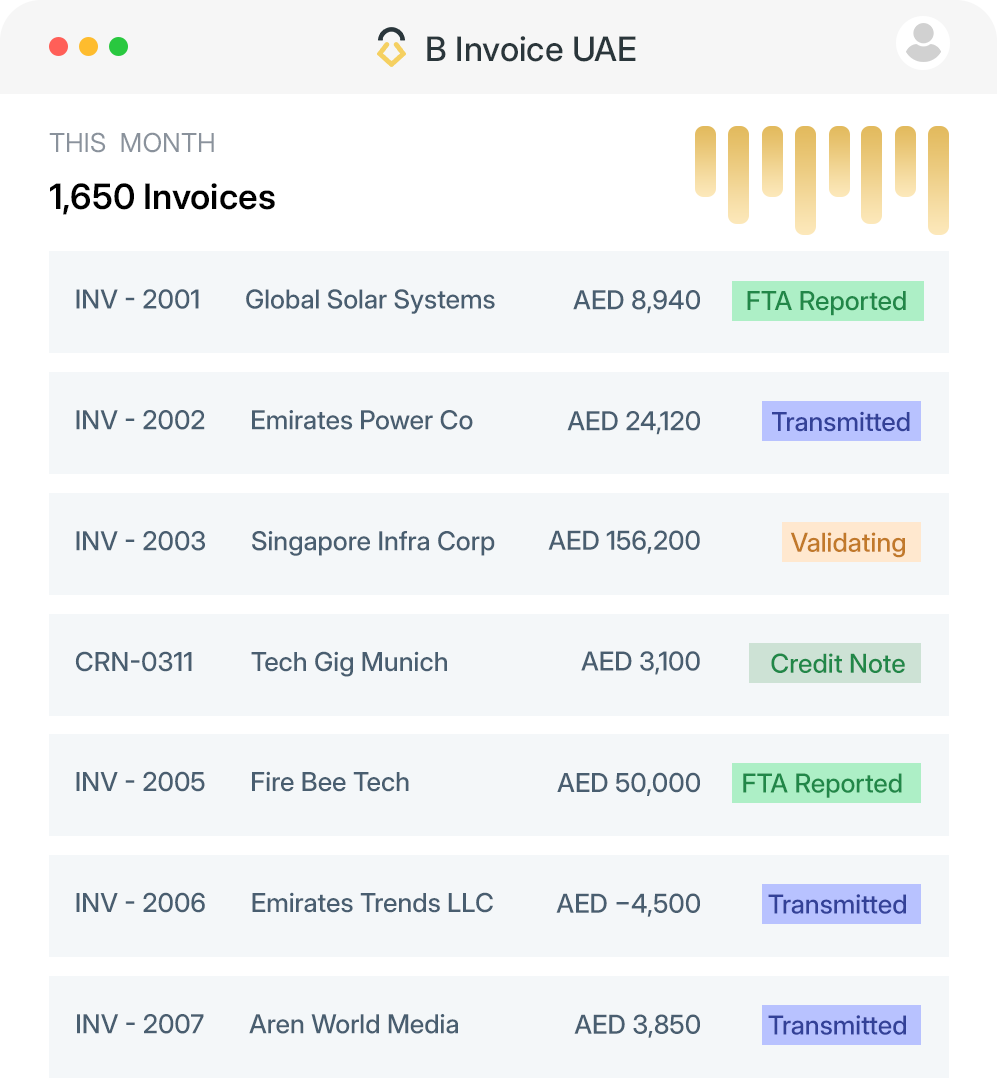

Time left to appoint an Accredited Service Provider
B Invoice Connects to





The distinction most buyers miss
Pre-approved is not accredited.
Pre-approved only
Can join the pilot
- Limited to pilot and testing activity
- Cannot support production go-live on its own
- Must still complete full accreditation
- Risk of missing 1 January 2027 sits with you
Accredited - Bee Aura Tech
Can operate in production
- Completed the MoF and FTA accreditation process
- Authorised to validate, sign and transmit live invoices
- Appointable through EmaraTax today
- Peppol Access Point and SMP in our own right
Find your phase
Two questions. Then you know your date.
Implementation timeline
The dates that govern your programme
|
Category
|
Appoint an ASP by
|
Mandatory from
|
Notes
|
|---|---|---|---|
|
Large businesses — annual revenue AED 50m or more
|
30 Oct 2026
|
1 Jan 2027
|
Extended from 31 July 2026. Receiving capability required from the same date.
|
|
Other businesses — under AED 50m
|
31 Mar 2027
|
||
|
Government entities
|
31 Mar 2027
|
1 Oct 2027
|
B2G flows land here.
|
|
Any business, voluntarily
|
From 1 Jul 2026
|
Optional
|
Pilot open. No penalty exposure during the voluntary period.
|
Appointing late is expensive even when it is legal
How the UAE model works
A five-corner network, not a government portal
CORNER 1 → 2
You and your ASP
CORNER 3
Buyer's ASP
CORNER 4
Your buyer
CORNER 5
The FTA
PDFs stop being invoices
Scope is B2B and B2G
The FTA does not validate
What we actually do
Nobody in your finance team learns anything new.




< 3 wks
100+
> 95%
1,500+
Cost of getting it wrong
The penalties run monthly, and they stack
|
Violation
|
Penalty
|
Accumulation
|
|---|---|---|
|
Failure to implement the system, or appoint an ASP, by your deadline
|
AED 5,000
|
Per month or part month
|
|
E-invoice not issued or transmitted within the required window
|
AED 100 / invoice
|
Capped at AED 5,000 per month
|
|
Electronic credit note not transmitted on time
|
AED 100 / note
|
Capped at AED 5,000 per month
|
|
Issuer fails to report a system failure in time
|
AED 1,000 / day
|
Daily, uncapped
|
|
Recipient fails to report a system failure in time
|
AED 1,000 / day
|
Daily, uncapped
|
|
ASP not updated with changes to registered information
|
AED 1,000 / day
|
Daily, uncapped
|
The fines are not the real exposure
Partner programme — UAE
Your clients are already asking you which ASP to appoint.
Referral
15%
- No technical work on your side
- Bee handles the full sales cycle
- Paid quarterly on collected revenue
- Co-branded client collateral
- Independence preserved you are not the vendor
Reseller
18%
- You bill the client, Bee bills you
- Partner portal with multi-client dashboard
- Free onboarding for your first 3 clients
- Named partner manager at Bee
- Firm listed on Bee's UAE partner page
Managed Partner
Contact sales
- You keep 100% of enablement fees
- Optional white-label portal
- Bee provides L2/L3 escalation only
- Free staff certification and training
- Minimum 10 client commitment
A partner portal, not an email thread
Why audit firms specifically
Independence stays intact
Free UAE e-invoicing certification for your team
Coverage across the Emirates
Wherever your entity is licensed, the obligation is federal

Dubai
UAE
Sharjah
Ras Al Khaimah
Ajman
Umm Al Quwain
Fujairah
Multi-emirate groups
Free zone does not mean exempt
What you get
One dashboard, one control set, one support model

Single dashboard
100+ validation checks

Automatic status write-back

AI-driven extraction

2-way and 3-way matching

Automated tax reconciliation

Role-based access & 2FA

UAE data residency

UAE-based team
UAE e-invoicing FAQ
What finance and tax teams ask us
Is Bee Aura Tech an accredited service provider in the UAE?
Yes. Bee Aura Tech holds Accredited Service Provider status with the UAE Ministry of Finance and the Federal Tax Authority, and is a Peppol-accredited Access Point and Service Metadata Publisher in its own right. We provide written confirmation of our status on request, and you can appoint us through EmaraTax.
What is the deadline to appoint an ASP in the UAE?
30 October 2026 if your annual revenue is AED 50 million or more, extended from 31 July 2026 by ministerial decision in May 2026. Businesses below AED 50 million and government entities must appoint by 31 March 2027. Failing to appoint carries a penalty of AED 5,000 for each month or part month of delay under Cabinet Decision No. 106 of 2025.
When does UAE e-invoicing become mandatory?
1 January 2027 for businesses with annual revenue of AED 50 million or more, 1 July 2027 for businesses below that threshold, and 1 October 2027 for government entities. The pilot and voluntary adoption window opened on 1 July 2026. The go-live dates did not move when the appointment deadline was extended.
What is the difference between a pre-approved and an accredited service provider?
Pre-approval permits a provider to take part in pilot and testing activity. Full accreditation is a separate and higher status required to operate in production once the mandate begins. Several dozen providers hold pre-approval and some have marketed it as accreditation. If you appoint a provider that does not complete accreditation before your go-live date, the penalty exposure is yours, so ask for written confirmation before signing.
Can I appoint more than one ASP?
No. Each business appoints a single Accredited Service Provider, which handles both outgoing and incoming invoices — your accounts payable and accounts receivable flows run through the same provider. If you want to change provider later, the update is made through the EmaraTax portal.
How do I formally appoint an ASP?
Through EmaraTax. Have a commercial agreement in place with an accredited provider first, then log in using UAE PASS or your registered credentials, verify your company details, and complete the appointment under the System Linking section. Selecting a provider commercially is not the same as appointing one — the EmaraTax step is what satisfies the deadline.
Can I submit e-invoices to the FTA directly?
No. The UAE operates a Peppol-based five-corner model in which invoices are exchanged between Accredited Service Providers and tax data is reported to the FTA across that network. Appointing an ASP is a legal requirement, not a convenience.
What format does a UAE e-invoice have to be in?
PINT AE, the UAE localisation of the Peppol International Invoice specification, transmitted as structured XML and populated according to the MoF mandatory field requirements. Scanned documents, PDFs, JPGs and paper invoices do not satisfy the requirement. A PDF can still be produced as a human-readable copy, but the XML is the tax document.
Are free zone companies exempt from UAE e-invoicing?
No. Free zone entities, including those in Designated Zones, are within scope. Designated Zone status affects the VAT treatment applied to supplies of goods, which changes how the transaction is categorised on the e-invoice, but it does not exempt the entity from the obligation. The system is federal and applies across Dubai, Abu Dhabi, Sharjah, Ajman, Ras Al Khaimah, Umm Al Quwain and Fujairah alike.
Are B2C invoices in scope?
Not in the current phase. The mandate covers B2B and B2G transactions. Business-to-consumer invoicing has been deferred and is expected in a later phase. Note that a business selling only to consumers may still be affected on the purchasing side if it buys from B2B or B2G suppliers.
Are QR codes or Arabic required on UAE e-invoices?
Neither. Unlike Saudi Arabia's Fatoora framework, the current UAE framework does not require a printed QR code, and Arabic is not mandatory — English is acceptable. No additional digital signature requirement has been announced beyond what the Peppol framework already supports.
Does e-invoicing apply within the same VAT group?
Yes. E-invoicing requirements apply to eligible transactions even when they occur between entities belonging to the same VAT group.
Which ERP systems do you integrate with?
Not in the current phase. The mandate covers B2B and B2G transactions. Business-to-consumer invoicing has been deferred and is expected in a later phase. Note that a business selling only to consumers may still be affected on the purchasing side if it buys from B2B or B2G suppliers.
How long does implementation take?
Typically two to three weeks from kickoff to production for ERP-integrated customers, and faster for API, upload or in-platform invoicing. The constraint is usually master data quality — counterparty TRNs, legal names and identifiers — rather than the integration itself, which is why appointing early and testing during the voluntary window matters more than the go-live date.
What does it cost?
Pricing depends on entity count, invoice volume, invoice types and integration method, so we quote per organisation rather than publishing a list price. Contact us with those four figures and we will return commercial terms and an implementation plan. There is no charge for the readiness assessment or for processing a sample batch of your invoices.
We are an audit firm. Can we partner with you?
Yes, and it is the partner profile we are actively building in the UAE. Three tiers are available: Referral at 15% recurring for the life of the account with no technical work on your side, Reseller at 18% off list where you own the client relationship and set your own retail price, and Managed Partner where you run first-line support with an optional white-label portal. Reseller and Managed tiers include partner portal access and free staff certification. See the programme.
Two conversations. Pick one.
UAE e-invoicing software and Accredited Service Provider services
Bee Aura Tech holds Accredited Service Provider status with the UAE Ministry of Finance and the Federal Tax Authority and provides B Invoice, an e-invoicing compliance platform for businesses operating in Dubai, Abu Dhabi, Sharjah, Ajman, Ras Al Khaimah, Umm Al Quwain and Fujairah. The platform reads accounts payable and accounts receivable invoice data directly from Oracle Cloud ERP, Oracle Fusion, SAP S/4HANA, SAP ECC, Microsoft Dynamics 365, Infor, any other ERP or non-ERP application, converts each document to the PINT AE structured XML format, applies the digital signature, transmits it across the Peppol network to the buyer’s Accredited Service Provider, and reports the Tax Data Document to the FTA E-Billing System.
The UAE Electronic Invoicing System is governed by Federal Decree-Law No. 17 of 2025 together with Ministerial Decisions No. 243 and No. 244 of 2025 as amended in May 2026, with administrative penalties under Cabinet Decision No. 106 of 2025. Businesses with annual revenue of AED 50 million or more must appoint an Accredited Service Provider through EmaraTax by 30 October 2026 and go live by 1 January 2027. Businesses below that threshold appoint by 31 March 2027 and go live by 1 July 2027, and government entities go live by 1 October 2027. A pilot and voluntary adoption window has been open since 1 July 2026, and voluntary adopters carry no penalty exposure during that period.
The UAE has adopted a Peppol-based five-corner Decentralised Continuous Transaction Control and Exchange model. VAT-registered businesses cannot submit invoices to the FTA directly and may appoint only one Accredited Service Provider, which handles both outbound and inbound invoice flows. Scope covers B2B and B2G transactions; B2C is excluded from the current phase. Full accreditation is distinct from pre-approval: pre-approved providers may participate in pilot activity, while full accreditation is required to support production e-invoicing from the mandatory go-live date. The FTA E-Billing System acts as a tax data repository for oversight rather than an invoice validation platform, so validation takes place at the Accredited Service Provider layer.
B Invoice supports UAE VAT at 5% together with zero-rated, exempt, out-of-scope and reverse charge treatments, TRN validation, Designated Zone handling, electronic tax invoices and electronic credit notes, more than 100 pre-transmission validation checks, automated tax reconciliation between ERP and reported data, error resolution workflows, malfunction notification handling and jurisdiction-configurable archiving on Microsoft Azure. Implementation for ERP customers typically completes within two to three weeks of kickoff. Bee Aura Tech is a Peppol-accredited Access Point and Service Metadata Publisher, ISO 27001:2022 and ISO 22301 certified, and operates a UAE partner programme for audit, tax and accounting firms with referral, reseller and managed partner tiers, partner portal access and free staff certification.
The same platform covers e-invoicing mandates in Saudi Arabia, Oman, Malaysia, India, Singapore, Germany, France, Vietnam, Colombia and the United Kingdom, so regional groups run one integration rather than one per country. For the global platform overview, see B Invoice multi-region e-invoicing compliance.
This page is provided for general information and does not constitute tax or legal advice. E-invoicing mandate dates, thresholds and technical specifications are set by the UAE Ministry of Finance and the Federal Tax Authority and are subject to change. Confirm your obligations with a qualified UAE tax advisor, and confirm any service provider’s accreditation status in writing before appointing them. Last verified: 3 September 2026.